
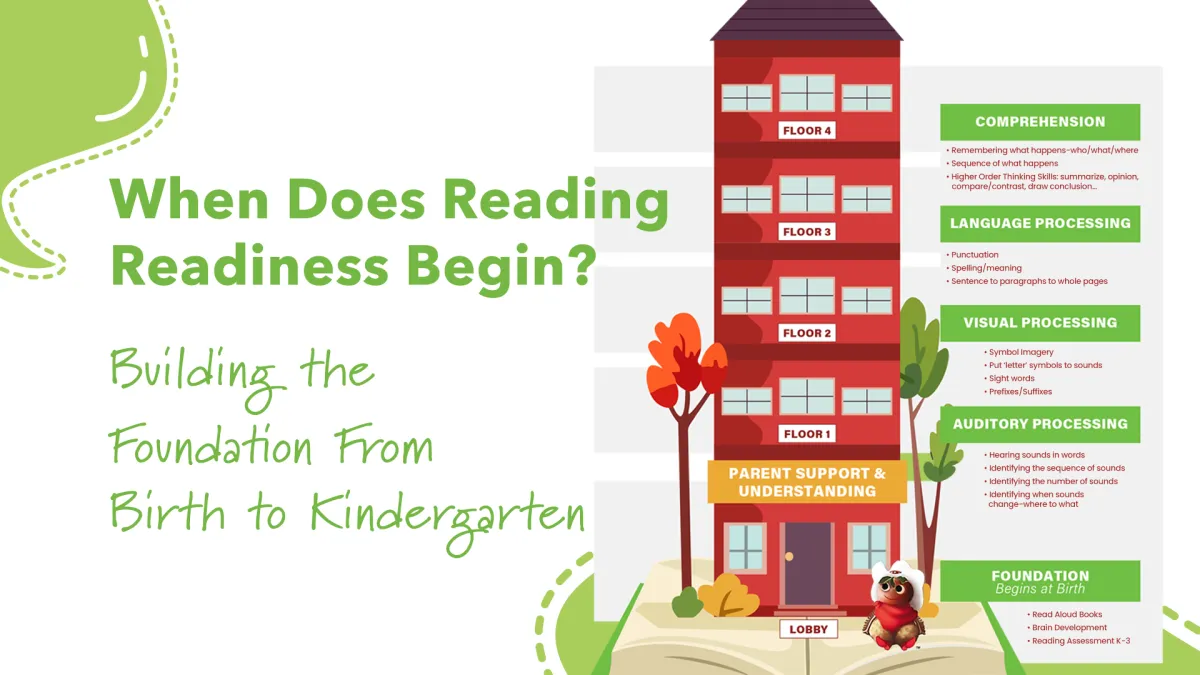
When Does Reading Readiness Begin? Building the Foundation From Birth to Kindergarten
By Kristin Cetone — Retired Title 1 Reading Specialist (Grades K–3), Children's Book Author, and Owner of Nuts About Reading and Buckaroo Buckeye
Quick Answer
Reading readiness begins at birth, not on the first day of school. The brain builds pre-reading skills — auditory processing, language processing, and bilateral coordination — long before a child ever sees a letter. Parents and caregivers can strengthen this foundation through everyday activities like talking, singing, reading aloud, and simple movement games from infancy through kindergarten.
Why a Strong Reading Foundation Matters More Than Ever
Artificial intelligence is reshaping how we work and learn, and it isn't going anywhere. But AI is only as accurate and reliable as the people who build it — and the people who use it. To ask AI a good question, and to judge whether its answer is actually correct, you have to be a skilled reader first.
That's the paradox of the AI era: the more we rely on AI, the more essential strong reading skills become. AI can support literacy instruction, but it cannot build a child's reading foundation for them.
When Does Reading Readiness Actually Begin?
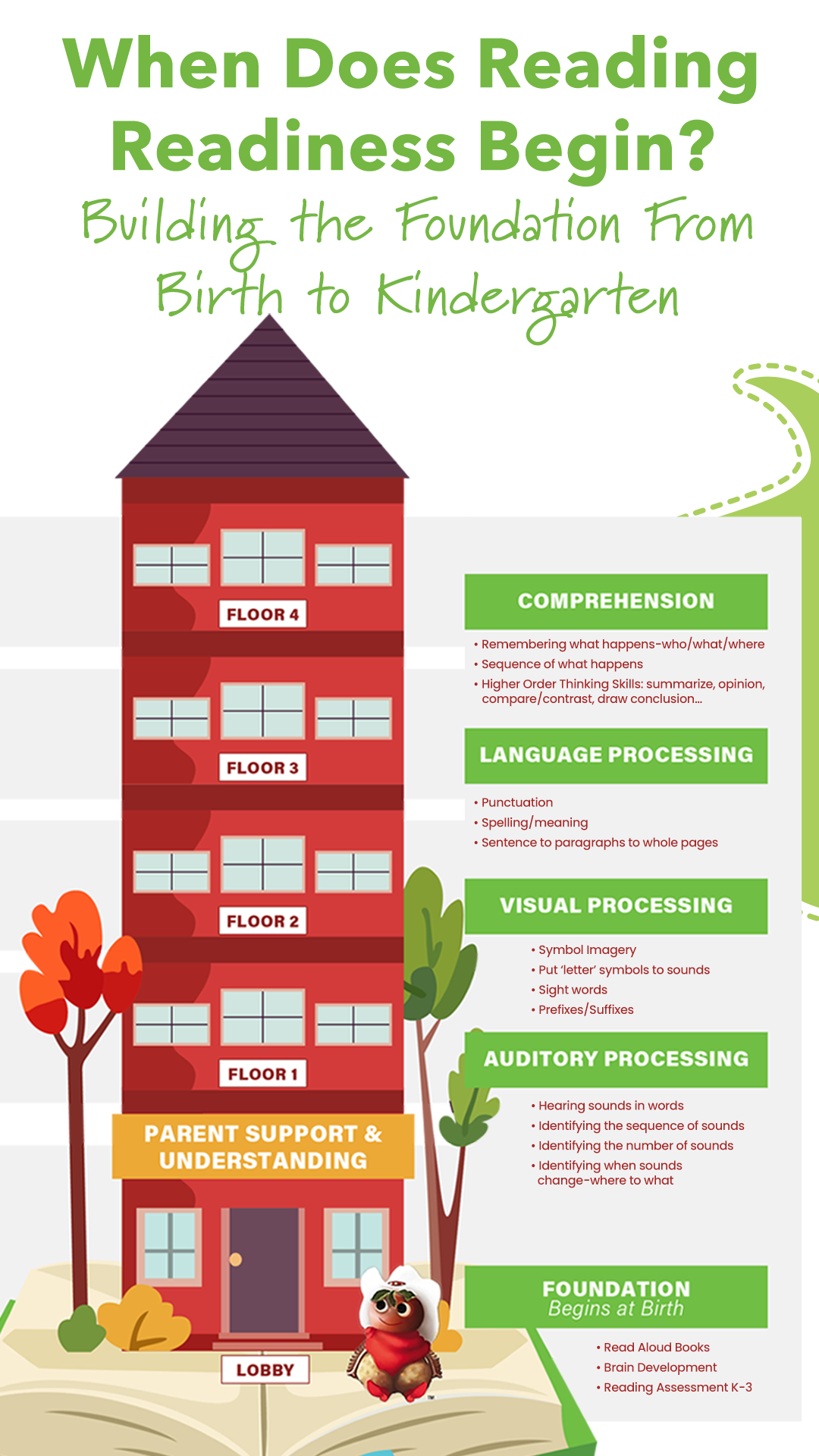
Reading readiness begins at birth and continues through a child's first year of school. Reading is not an instinct — unlike speaking, it's a learned skill. And like any structure, a reading "building" is only as strong as its foundation.
As a retired Title 1 Reading Specialist for grades K–3, I saw firsthand that strong reading instruction requires more than best-practice curriculum. It requires the right foundation, laid years before formal instruction starts. Several regions of the brain are involved in this process — I'll leave the neuroscience to neuroscientists — but as an educator who has tutored struggling readers for years, my focus is on what actually works: simple, repeatable activities.
It's also worth noting: these foundational activities aren't just for babies. Older children and even adults with gaps in their reading foundation can benefit from revisiting them. Any hole in the foundation, at any age, needs to be filled.
What Is "Learn to Read" vs. "Read to Learn"?
Learn to Read (Kindergarten–Grade 3): Children are building the mechanical skills of reading — phonics, decoding, fluency, and comprehension basics.
Read to Learn (Grade 3 and up): Once those skills are solid, children shift to using reading as a tool to absorb new information across every subject.
If the "Learn to Read" foundation is weak, the "Read to Learn" stage — and everything built on top of it — becomes much harder.
Reading Readiness Activities From Birth to Kindergarten
Birth to Toddler: Build Auditory and Language Skills
Play musical games and sing rhyming songs to build auditory pattern recognition.
Echo your baby's babbling sounds back to them.
Play peek-a-boo and face-matching games.
Take turns in simple games so children learn to process social sounds and cues.
Name everyday objects — toys, food, animals — to build vocabulary and language processing.
Use an expressive, higher-pitched voice to help babies tune in to sounds.
Read aloud daily, pointing to pictures and words as you go.
Expose children to different languages and musical tones.
Encourage pretend play with dolls or toy phones.
Limit passive screen time; favor video calls with family over TV or phone/laptop screens.
Infant to Preschool: Build Visual Tracking and Coordination
Use black-and-white tracking cards, slowly moving them across your baby's field of vision while making a rhythmic sound (like "tick-tock"). This links visual tracking with auditory processing — a critical early step toward reading.
Add physical movement to songs as your child grows.
Strengthen spatial awareness with simple positional play: put a toy "under" the table, "over" the table, or "inside" a box.
Preschool to Kindergarten: Build Number Sense and Bilateral Coordination
Practice counting and grouping everyday objects — blocks, stairs, pieces of fruit.
Have your child hold a crayon or marker in each hand and draw shapes or patterns simultaneously. This builds bilaterality — the brain's ability to coordinate both hemispheres, which is essential for reading. Reading doesn't happen in one side of the brain; it moves back and forth between both.
Frequently Asked Questions
Does reading readiness really start at birth? Yes. The brain begins building the auditory, language, and coordination skills that reading depends on from infancy — well before formal school instruction begins.
Can AI help teach a child to read? AI can support reading instruction as a tool, but it can't replace the foundational activities — talking, singing, reading aloud, and movement-based play — that build a child's brain for reading. AI is also only as reliable as the reader evaluating its output.
What is the difference between "Learn to Read" and "Read to Learn"? "Learn to Read" (roughly K–Grade 3) is about mastering the mechanics of reading. "Read to Learn" (Grade 3 and up) is about using reading as a tool to learn other subjects. A shaky foundation in the first stage makes the second stage much harder.
Are these activities only for babies? No. Older children and adults with gaps in their reading foundation can benefit from the same types of activities — it's never too late to reinforce the foundation.
The Bottom Line
Reading success is built, not born. The activities you do with a child from birth through kindergarten are the cement that forms the foundation — everything they learn in the classroom afterward is built on top of it.