
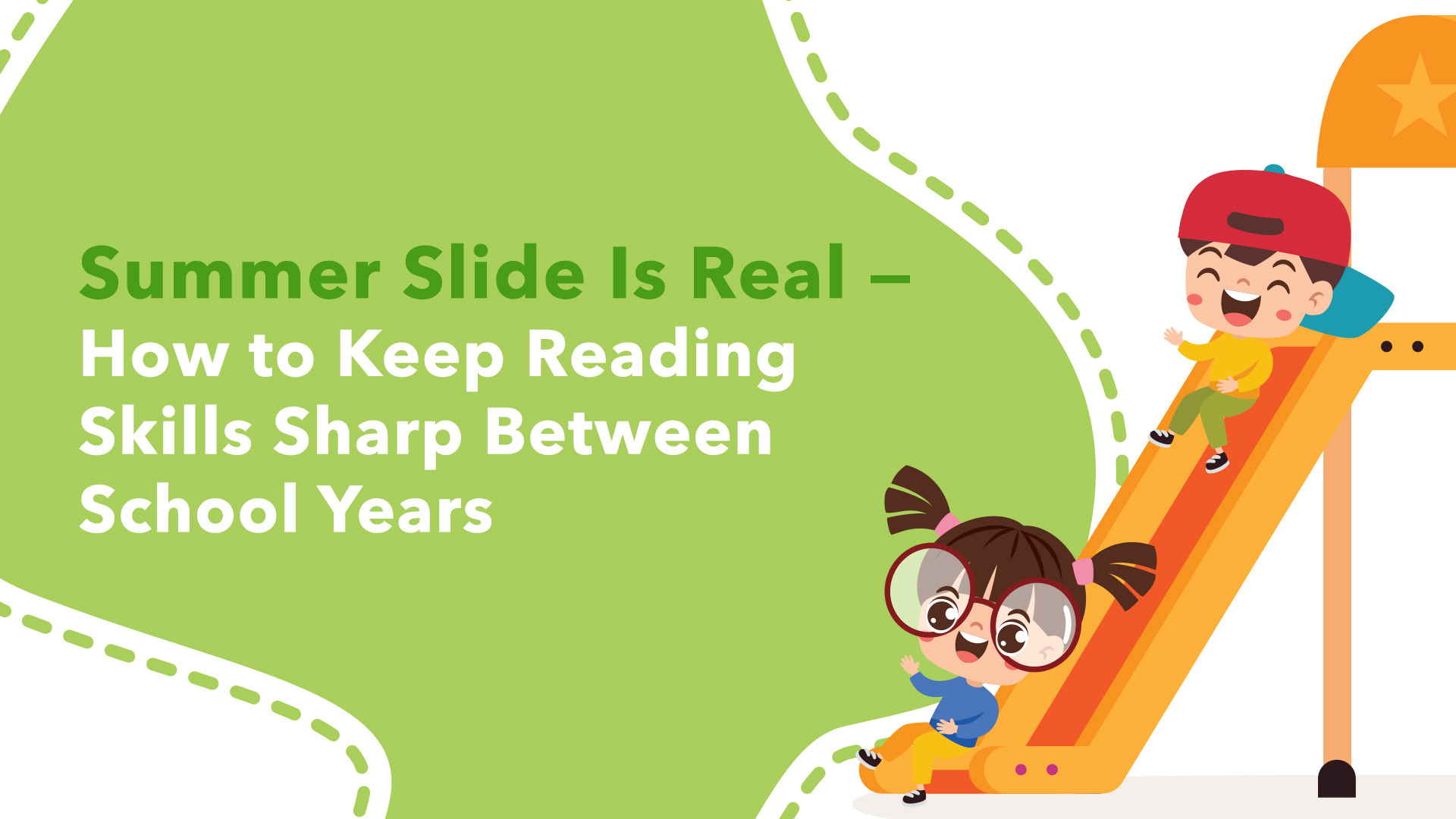
Summer Slide Is Real — How to Keep Reading Skills Sharp Between School Years
How to Keep Reading Skills Sharp Between School Years
It has a deceptively cheerful name for something that causes real academic harm. The summer slide — the loss of reading skills and knowledge that occurs during the summer months when children are out of school — is one of the most well-documented and consistently underestimated phenomena in education research.
Understanding what it is, who it affects most, and what families can do about it is one of the most practical things a parent can engage with before the school year ends.
What the research actually shows
Studies on summer learning loss have been conducted since the 1970s, and the findings are remarkably consistent. On average, students lose approximately one to three months of reading progress over the summer months. By the time a student reaches fifth grade, summer learning losses can account for more than half of the total achievement gap between lower- and higher-income students.
The effect is cumulative. A child who loses a small amount of reading progress each summer is not just behind at the start of each school year — they are further behind than they were the year before. Research has found that as much as two-thirds of the reading achievement gap between higher- and lower-income students by ninth grade is attributable to accumulated summer learning loss in the elementary years, not to differences in school-year learning.
Who is most affected
Summer slide affects children across the socioeconomic spectrum, but the effects are significantly more severe for children from lower-income households. Higher-income children, on average, actually make modest reading gains over the summer — they have access to books, educational travel, enrichment programs, and environments where reading is woven into daily life. Lower-income children, who are less likely to have access to those resources, lose ground.
This disparity compounds year after year, which is one of the primary reasons researchers identify summer learning loss as a major structural driver of educational inequality — not a minor inconvenience.
Why does it happen?
The mechanism behind summer slide is not complicated. Reading is a skill that is maintained through use. When children stop reading regularly, the neural pathways that support fluency, decoding automaticity, and comprehension begin to weaken. It is the same process that makes any skilled activity harder after extended time away.
For younger children still in the process of consolidating foundational reading skills, the regression can be particularly significant. A child who finished first grade with emerging phonics skills and a fragile sight word bank may enter second grade having lost a meaningful portion of both if the summer was spent in reading-free activity.
The summer slide is not inevitable
The research that documents summer slide also documents what prevents it. The most consistent finding: children who read during the summer — even moderately, even informally — either maintain their skills or continue to grow them. The threshold is not high. Studies have found that reading as few as four to six books over the summer can be enough to prevent significant regression.
The key is consistency over time, not intensity in any single session.
What families can do
Make books available. This sounds obvious, but access to books is a real predictor of summer reading. Children who have books in their home read more. Public libraries are a powerful resource — most offer summer reading programs specifically designed to maintain momentum across the break. If a child can choose their own books, they are significantly more likely to read them.
Follow the child's interests. Summer is not the time for assigned reading that doesn't engage. The goal is to keep the habit of reading alive, which means letting the child drive the content. A child who spends the summer reading graphic novels, sports almanacs, or fantasy fiction is maintaining real skills — decoding, fluency, vocabulary, and comprehension don't care about genre.
Keep reading aloud — even to older children. Family read-aloud time in the summer is among the highest-value literacy activities available, and it requires no worksheets, no assessment, and no structure beyond choosing a book together. For children who are not yet reading independently, it maintains language exposure and builds the vocabulary and background knowledge that comprehension depends on. For children who can read, it exposes them to more complex text than they would likely choose independently.
Build reading into daily routine. Children are more likely to read consistently if it is a daily habit rather than an occasional activity. Fifteen to twenty minutes of reading before bed, or after lunch, or whenever it fits the family's schedule — maintained consistently across the summer — is sufficient to prevent significant regression and, for many children, to continue growth.
Use audiobooks strategically. For children who resist independent reading, audiobooks provide continued exposure to vocabulary, narrative structure, and language — all of which support reading development. They should not fully replace print reading, particularly for children who are still developing decoding skills, but they are a valuable tool in the summer toolkit.
Don't let the summer assessment wait until September. If a child struggled with reading during the school year, summer is actually an excellent time to assess where they are and begin addressing specific skill gaps — before the pressure of a new school year, when there is more flexibility in scheduling and less emotional weight around reading performance. Starting targeted support in July rather than waiting until October is a meaningful difference.
What to watch for at the end of summer
Before the school year begins, spend a few sessions reading with your child — both listening to them read aloud and discussing what they've read. You're looking for evidence of the skills they had at the end of the previous school year: fluency, sight word recognition, decoding of multi-syllable words, and comprehension.
If those skills seem significantly diminished, it's worth communicating with their teacher at the start of the year rather than waiting for the school's assessment cycle to identify the regression. Early awareness allows for earlier support.
The larger point
Summer slide is well-documented, largely preventable, and significantly underestimated by most families. The research suggests that what children do — or don't do — in the months between school years matters to their long-term literacy trajectory in ways that compound over time.
The solution is not a rigid summer school program or a stack of workbooks. It is the maintenance of a reading habit through access to books children care about, regular time in which reading happens, and adults who model and value it.
Summer is long. Fifteen minutes of reading a day across twelve weeks is more than twenty hours of literacy practice. That is not nothing. For a child whose skills are fragile, it may be the difference between walking into September ready to build on what they know — and spending the first two months of school reconstructing what they lost.