
Building Levels of Reading
How Reading Is Built: A Parent's Guide to Every Stage of Literacy
Reading is not a single skill — it's a layered developmental process that begins at birth. Understanding how it works puts you in a better position to support your child at every stage.
Most parents know when their child is struggling to read. Fewer know why. Is it the sounds? The letters? The words themselves? Or something further upstream, in how language is being processed at all?
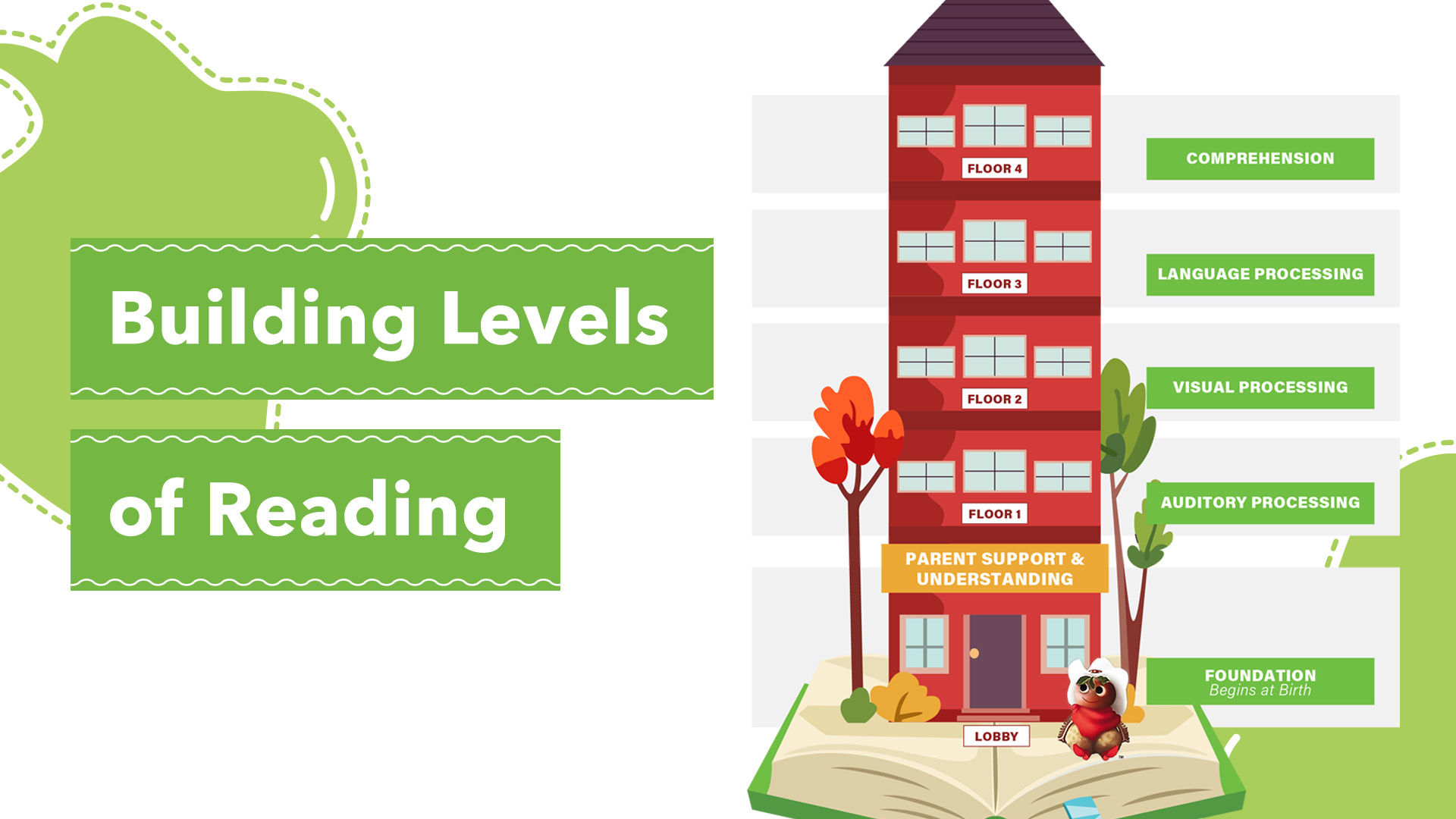
The answer matters — because reading is not one thing. It is a sequence of interconnected skills, each one building on the last. Research has come to describe it as a building: a structure with floors that must be constructed in order, from the ground up. A child who struggles at any stage is not simply "a bad reader." They are missing a floor — and identifying which one changes everything about how you help them.
This guide walks through every layer of that structure, grounded in current research on literacy development, with statistics that put the stakes in context.
Why Reading Proficiency Matters More Than Most Parents Realize
Before examining how reading is built, it's worth understanding what is at stake when it isn't built well. The research on early literacy outcomes is both compelling and sobering.
65% of America's fourth graders do not read at a proficient level, according to national assessment data. 23% of students reading below basic level in third grade fail to finish high school on time or at all. Children who are read to at least three times per week are nearly twice as likely to score in the top 25% on reading assessments. And children with the lowest reading scores — who represent only 33% of all students — account for 63% of all children who do not graduate from high school.
The Annie E. Casey Foundation's landmark research identified third grade as the pivotal literacy checkpoint: children who are not reading at grade level by the end of third grade are at significantly elevated risk of never catching up. By fourth grade, the curriculum shifts from learning to read to reading to learn — and students who haven't made that transition find that up to half of the printed curriculum becomes incomprehensible.
"Third-grade reading level can predict, with reasonable accuracy, a student's likelihood of graduating from high school."
The good news: early identification and targeted support can change trajectories dramatically. That's why understanding the architecture of reading — which skills come first, and which depend on which — is not an academic exercise. It is a practical tool for every parent.
The Architecture of Reading
Reading researchers and educators describe literacy development as a layered structure. Each layer must be stable before the next can be reliably built. What follows is a description of each layer — what it is, what the research says, and what it looks like when it's working (or not).
THE FOUNDATION
Literacy development begins at birth — long before a child encounters a single letter. Every conversation, song, storybook, and narrated moment contributes to the neural architecture that reading will later depend on. Infants are absorbing the rhythms, sounds, and structures of language from their very first days.
By age two, a child's brain is as active as an adult's. By age three, it is more than twice as active, and roughly 85% of the brain is developed. This period is a critical window for language acquisition — yet formal literacy instruction in most school systems doesn't begin until age five. The gap between brain development and institutional education makes what happens at home profoundly significant.
One of the most well-supported findings in literacy research is the impact of reading aloud. Children whose parents read to them one book a day hear over 290,000 words by age five. Books for children contain approximately 50% more rare vocabulary than everyday conversation — meaning books expose children to language they are unlikely to encounter anywhere else. Children who are frequently read to are not only more likely to score higher in reading assessments, they are also more likely to demonstrate early numeracy skills and broader cognitive readiness for school.
Physical activity also plays an underappreciated role. Spatial awareness, bilateral coordination, motor sequencing, and working memory — all developed through free play and physical movement — are foundational cognitive skills that support the learning processes reading demands.
FLOOR 1 — Auditory Processing & Phonemic Awareness
The first active floor of reading development has nothing to do with letters. Before a child can decode written words, they must be able to hear and manipulate the individual sounds — called phonemes — that make up spoken language.
Consider the word "cat." It has three letters, but it also has three distinct sounds: /k/, /æ/, /t/. These are not the same thing, and the distinction matters. A child who cannot isolate the /k/ in "cat," or who cannot tell you that "cat" and "hat" share a final sound, has not yet developed the phonemic awareness that reading instruction depends on.
Research is clear that phonemic awareness is one of the strongest early predictors of reading success. The National Early Literacy Panel's meta-analysis of approximately 300 studies confirmed that phonological awareness measured in preschool and kindergarten is among the most reliable predictors of later reading outcomes — including decoding, reading comprehension, and spelling. Children who enter kindergarten with low levels of phonemic awareness are likely to be the same children who struggle in first and second grade.
This is why effective early literacy instruction introduces sounds before symbols. The brain needs to own the sounds before it can attach written representations to them. When that sequence is reversed — letters first, sounds second — children often learn to recite the alphabet without developing the underlying auditory architecture that decoding requires.
FLOOR 2 — Visual Processing, Phonics & Sight Words
Once a child has internalized the sounds of language, the written symbols — letters and letter combinations — can be introduced with their corresponding sounds. This is the domain of phonics, also called decoding: the process of translating printed letters into spoken sounds and, from there, into words.
English phonics is notoriously complex. The language contains 44 phonemes but only 26 letters to represent them, and its history of borrowing from Latin, French, Norse, and other sources has produced a spelling system full of patterns and exceptions. Effective phonics instruction doesn't pretend this complexity doesn't exist — it sequences instruction so that regular patterns are mastered before exceptions are introduced.
Alongside phonics, this floor encompasses sight word recognition — the automatic identification of high-frequency words. Research has confirmed that a relatively small set of words accounts for the majority of text in everyday reading. When a child must laboriously decode the word "the" every time it appears, cognitive resources that should be directed toward comprehension are instead consumed by the decoding process. Reading slows, meaning suffers, and frustration follows.
Sight word mastery is, in effect, the development of reading muscle memory. Just as a skilled pianist doesn't consciously locate middle C, a fluent reader doesn't consciously decode "though." The word is simply recognized — and the reader moves on to meaning. Building that automaticity is a concrete, teachable skill, and it has measurable impact on reading fluency and comprehension.
FLOOR 3 — Language Processing, Grammar & Vocabulary
Reading is more than decoding. A child who can sound out every word on the page but doesn't understand how those words function together hasn't yet arrived at reading. Floor three is where the structural and semantic dimensions of language come into focus.
This includes morphology — understanding prefixes, suffixes, and root words. A child who knows "happy" but doesn't recognize "happiness" or "unhappy" as variations on the same concept will encounter comprehension obstacles that have nothing to do with decoding. As vocabulary grows in complexity, so does the importance of understanding how words are built and how they change meaning in different forms.
Grammar and punctuation play functional roles in comprehension that are often overlooked in discussions of reading instruction. A period signals more than a stop — it signals to the brain that a complete thought has landed and can be stored and processed. A comma creates a different kind of pause. A question mark shifts interpretation entirely. Children who read through punctuation without processing it are absorbing less meaning than they could, even when their decoding is accurate.
Vocabulary breadth is also significant at this level. Studies have found that children who are regularly read to and engaged in rich conversation develop larger vocabularies earlier — and vocabulary at kindergarten entry is predictive of reading comprehension in later grades. This is one of the reasons that reading aloud to older children, even those who can technically read independently, remains valuable: it exposes them to more complex sentence structures and vocabulary than they are likely to encounter in texts they can decode on their own.
FLOOR 4 — Comprehension
Comprehension is the purpose of reading. Everything below it — the sounds, the symbols, the sight words, the grammar — exists in service of this final floor. A child who comprehends what they read can summarize, recall details, draw inferences, evaluate arguments, compare perspectives, and engage critically with what they encounter on the page.
These are not merely school skills. They are thinking skills — skills that transfer to every domain of academic and adult life.
The critical insight from reading research is that comprehension cannot be strengthened in isolation from the floors beneath it. A child who struggles with comprehension may not have a comprehension problem at all. The difficulty may be rooted in insufficient phonemic awareness, weak decoding automaticity, limited sight word recognition, or underdeveloped vocabulary. Addressing those lower floors, rather than simply assigning more reading, is typically what produces lasting improvement.
This is also why research on spoken language comprehension is relevant for parents. Children and adults can comprehend spoken language at higher levels than they can read. Reading aloud to children — presenting them with more complex material than they could decode independently — builds the conceptual and vocabulary knowledge that reading comprehension will later depend on. Knowledge gaps, not just skill gaps, limit what a child can understand.
What Parents Can Do
The research on parental involvement in literacy development is unambiguous. Parent involvement and time spent reading at home are among the major predictors of reading success — across income levels, school types, and geographic contexts. Less than 50% of parents in the United States report reading daily to children under five. That number represents an enormous opportunity.
Read aloud — and keep reading aloud. Children who are read to at least three times per week by a family member are nearly twice as likely to score in the top quartile on reading assessments. Even after a child can read independently, reading aloud exposes them to vocabulary and sentence structures beyond their current decoding level — building the background knowledge and language processing skills that comprehension depends on.
Play with sounds before letters. Rhyming games, tongue twisters, clapping syllables, and identifying beginning sounds in words all build the phonemic awareness that decoding will later require. These activities don't require materials — only attention and a few minutes of daily engagement.
Don't wait for school to signal a problem. Research consistently shows that students with below-grade-level reading in third grade rarely close the gap without targeted intervention. Early identification — ideally before formal reading instruction begins — produces substantially better outcomes than later remediation. If you notice difficulty with sounds, rhymes, letter recognition, or word recall, that is meaningful information.
A note on the third-grade milestone. Third grade represents a well-documented inflection point in literacy development. Before it, children are learning to read. After it, they are expected to read to learn — and the curriculum accelerates on that assumption. Students who arrive at fourth grade without fluent decoding and basic comprehension skills face a compounding disadvantage: the gap between what they can read and what they need to read widens with each passing year.
Early Warning Confirmed, the Annie E. Casey Foundation's landmark research update, found that students with the lowest reading scores account for 33% of all students — but 63% of all children who do not graduate from high school. Reading proficiency by third grade is not just an academic milestone. It is one of the most reliable predictors of long-term educational and economic outcomes available to educators and parents.
"If we don't get dramatically more children on track as proficient readers, the United States will lose a growing and essential proportion of its human capital to poverty — and the price will be paid not only by individual children and families, but by the entire country."
Identifying Which Floor Needs Work
One of the most practical implications of the building model is that it provides a diagnostic framework. When a child struggles, the question isn't only "how much are they struggling?" It's "where in the building is the difficulty?"
A child who cannot isolate phonemes has a floor one issue. A child who decodes laboriously but accurately has a floor two issue — likely in automaticity rather than phonics knowledge. A child who reads fluently but doesn't retain meaning may have gaps at floor three (vocabulary, grammar) or floor four (comprehension strategies). And a child who seems uninterested in reading may have a floor one or two difficulty that has made reading effortful enough to avoid.
This is why assessment matters — not to label a child, but to locate the gap so that effort can be directed where it will actually help. The Nuts About Reading assessment is designed to help parents do exactly this, at home, without clinical training. Understanding which floor needs attention turns a vague worry into an actionable plan.